Explainable AI
Connect each observation to relevant sources, reasoning, limitations and open questions so a reviewer can inspect how it was reached.
Technology
Six proposed disciplines connect business context to inspectable evidence and informed decisions.
Technology identity
Explainable AI · Graph Intelligence · Data Science · Knowledge Engineering · Diagnostic Intelligence · Decision Science
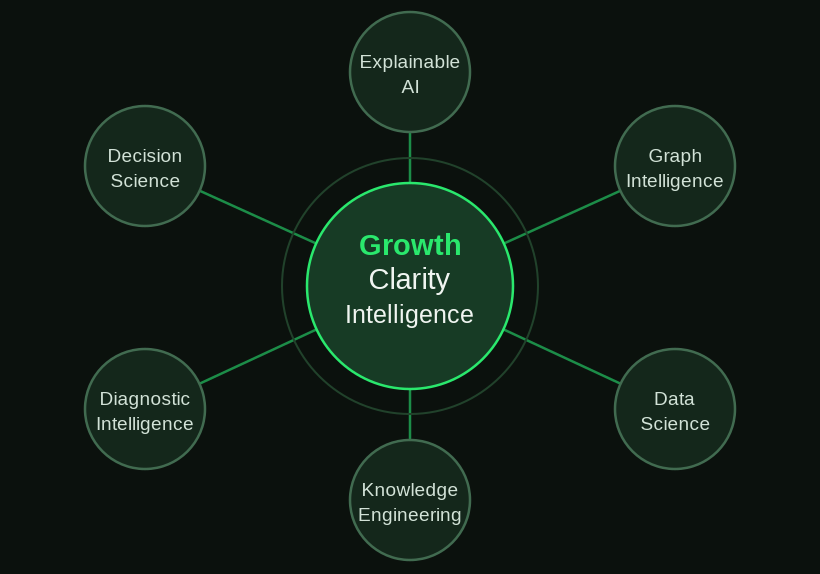
Technology foundations
Connect each observation to relevant sources, reasoning, limitations and open questions so a reviewer can inspect how it was reached.
Model relationships among lifecycle stages, activities, metrics and outcomes. Use those connections to guide investigation across teams.
Compare like-for-like cohorts and time windows. Check baselines, variation and sample sufficiency before interpreting performance changes.
Represent business concepts, metric definitions and organisational context in reusable structures that can be adapted to each business.
Frame possible growth constraints as hypotheses and examine the evidence for and against each one.
Compare explanations and intervention options against criteria such as feasibility, effort, expected impact and uncertainty.
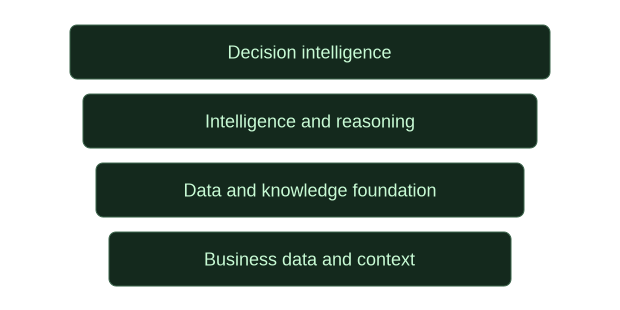
Conceptual architecture
Reviewed outcomes could feed back into organisational knowledge. The architecture is conceptual and its components are subject to development and validation.
Relationship modelling
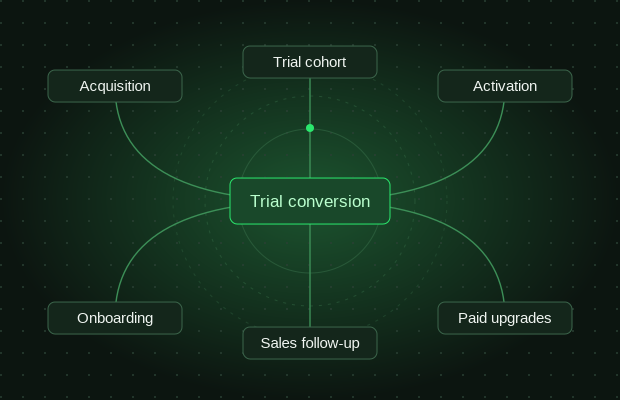
A knowledge graph could connect a change in trial conversion with cohorts, activation behaviours or an onboarding release. Relationships provide paths to inspect and suggest comparisons to run. Investigators would still need suitable evidence to assess causation.
Statistical evaluation would account for cohort size, seasonality, changes to definitions and missing information. The intended output includes relevant time windows and source references so that reviewers can reproduce or challenge a comparison.
Responsible AI & data governance
Explanations should show the observation, evidence, assumptions and open questions. Reviewers should be able to correct context, inspect contradictory evidence and decide whether to proceed or gather more information.
Proposed safeguards include scoped access, data minimisation, separation between organisations and audit records for reviews. The research programme will evaluate how these controls fit real investigation workflows.
