Why isn’t demand becoming revenue?
Investigate acquisition, lead quality, qualification and sales conversion to see where demand drops out.
Evidence-Aware Growth Decision Intelligence
Connecting marketing, sales, product, customer and revenue intelligence to help SaaS businesses investigate growth constraints before committing resources to a solution.
Observe · Investigate · Evaluate · Decide · Learn
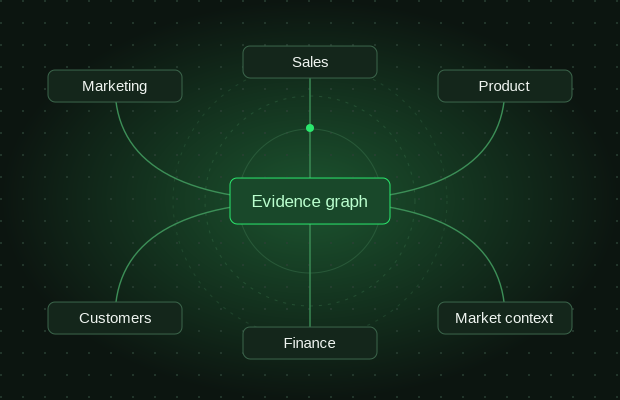
The problem
Your CRM shows pipeline. Analytics shows traffic. Product tools show usage. Finance shows revenue. When the evidence sits in separate tools and teams use different definitions, it’s easy to invest in a fix before understanding the problem.
The approach
Bring business performance, organisational context and expert interpretation together so reviewers can trace how a finding was reached.
| The challenge | Growth Clarity’s approach |
|---|---|
| Evidence is scattered. | Gather relevant measurements, business context and expert observations. |
| A metric has several definitions. | Check definitions, periods, populations and source limitations before comparing results. |
| A symptom looks like a cause. | Separate observations from hypotheses and examine competing explanations. |
| Data is missing or conflicting. | Document uncertainty and what information would help resolve it. |
| A proposed action lacks justification. | Link it to the evidence and reasoning for human review. |
These are product design goals. Availability varies by workflow during development.
Practical use cases
Investigate acquisition, lead quality, qualification and sales conversion to see where demand drops out.
Use cohort and business context to explore friction in onboarding, activation, adoption, retention and expansion.
Review attribution, incrementality and marketing mix modelling outputs. Check whether they answer comparable questions before interpreting differences.
Compare plausible explanations, evidence gaps and interventions before committing resources.
Some use cases are planned or rely on expert guidance. Automated diagnosis requires validation.
How it works
Define the decision, business context, customer segment and period.
Use relevant reports, supported inputs, questionnaire answers and expert observations.
Review definitions, comparability, missing inputs and conflicting information.
Record what the evidence supports, what contradicts it and what still needs testing.
Use human judgment to assess recommendations, limitations and the next step.
Over time, the platform aims to link approved actions to outcome reviews so future decisions can draw on what teams learned.
Evidence-aware decisions
A change in a metric is a signal. Its cause is a separate question. When information cannot support a finding, the review can record “Insufficient evidence to assess” and identify what to collect next.
Measurements and observations with identifiable sources.
Missing information, conflicts and untested assumptions.
Explanations that need further investigation.
Findings and actions assessed by an authorised reviewer.
Who it is for
Decide which growth questions warrant attention before allocating limited resources.
Investigate cross-functional problems with evidence from across the customer journey.
Structure client investigations and explain the evidence, interpretation and limitations.
AI and human judgment
Supported workflows combine deterministic calculations with AI-assisted analysis. AI can organise information and draft explanations. Reviewers check source values, assess whether the evidence supports an explanation and own the decision.
Development status
KPI and rule-based analysis, business-context capture, questionnaires, reporting and a specialised marketing measurement reconciliation workflow.
Shared evidence, cross-functional verification and outcome learning. Live integrations and diagnostic suitability require validation for each use case.